

The bells are here! Nearly a year ago, one of our families made a very generous donation to the school, which we used to purchase this set of Montessori Bells. The bells are the primary material which Montessori used in the 3-6 classroom to develop the auditory senses of children and for musical education. Although the bells are an integral part of Montessori education, and considered one of the basic "standardized" pieces of equipment which ought to be found in any 3-6 classroom, they are often absent due to the expense of the material, and very few Montessori schools actually have them available in the classroom (I only know of one school in Boulder County). As a result, we consider ourselves very fortunate to have been given a donation which made it possible for us to purchase this material.
We ordered the bells nearly a year ago from Neinhuis (the main supplier of Montessori materials and the original supplier of many materials to Dr. Montessori herself!). Neinhuis told us that the materials would be coming to the US on a ship from Holland (where Neinhuis is based), but was unable to give us an an exact date- apparently, they have a peculiar inventory management system in which they receive containers from Holland every few months but never know in advance what will be on them!
The bells are a little slice of history in their own right. Our bells were manufactured by hand in Tuscany by the Tronci Firm of Pistoja- the same family business (in fact, the same ten person factory) that Montessori purchased them from nearly a century ago (the Tronci family has weathered the vagaries of history- they began making musical instruments in the first half of the nineteenth century by making church bells using ancient Etruscan art techniques for casting bronze, then Luigi Tronci worked with Montessori to develop the Montessori Bells, and subsequently, in 1910, became famous for casting the first Italian cymbals, which fueled the American jazz movement until Mussolini came to power and declared jazz to be a sin). Anyhow, after a year of waiting, the bells arrived this Friday!

After a few hours of playing with the bells ourselves, my indulgent husband (and resident Montessori Bob Vila) went to work at constructing a beautiful cabinet for the new material. 


The name of the material, "The Montessori Bells," is actually a misnomer. The bells resulted from a collaboration between Dr. Montessori and Anna Maria Maccheroni. Ms. Maccheroni (1876-1965) came from an erudite family that placed great importance upon education, and she had been educated by a Froebelian tutor that the family employed at home. She met Montessori when she was a student at the university and happened to attend Dr. Montessori's lecture Pedagogical Anthropology for Teachers. Maccheroni was drawn to Montessori's work because she shared the belief that mental work and activity does not exhaust young children, but nourishes their mind and feeds their soul. Ms. Maccheroni ultimately became the directress of the Casa dei Bambini in Milan. The partnership between the two women was particularly beneficial to the development of musical materials as Ms. Maccheroni's musical talent and understanding of musical theory exceeded that of Montessori.
Montessori came to consider musical education as an integral part of her method; it fell into a broader category of education that she referred to as "sense education," or Sensorial Materials, which are didactic materials that were designed to develop all of the child's senses (visual, kinaesthetic, gustatory, olfactory, and auditory). Montessori believed that sensory impressions form the basis for higher forms of knowledge and intellectual activity (conceptual understanding, self-consciousness, etc) and that refining the child's sensory perception would lead to future cognitive gains. She also believed that her Sensorial materials were among her most important contributions to education: "In a pedagogical method which is experimental, the education of the senses must undoubtedly assume the greatest importance... from the biological side we wish to help the natural development of the individual; from the social standpoint it is our aim to prepare the individual for the environment. The education of the senses precedes that of superior intellectual activity and the child between the age of three and seven is in the period of formation. We can, then, help the development of the senses while they are in this period. We may graduate and adapt the stimuli, just as, for example, it is necessary to help the formation of language before it shall be completely developed."
In other words, just as we can assist a child in learning to read or to speak a new language by providing the appropriate environmental stimuli, we can assist children in developing their ability to perceive differences in color, form, dimensions, and pitch by providing appropriate materials and experiences. The materials that Montessori created to accomplish these tasks are so well designed that they have stood the test of time and, in addition to Montessori schools, continue to be widely used in occupational, speech, and vision therapy settings.
For musical/auditory development, Montessori and Maccheroni began by experimenting with music during line activities, to assist children in acquiring balance and equilibrium, but over time music became an integral part of the classroom environment and they found that children between the ages of four and seven are in a "sensitive period" for musical education (children are developing their auditory pathways, the same sensitive period which makes learning language possible). Just as a child exposed regularly to a foreign language during this time can acquire it with an ease and exactness that cannot be achieved later in life, children between the age of 4-7 can also learn music with similar ease; however, failure to provide the right stimuli and exposure during this sensitive period makes it unlikely that the child will develop the skill later to the same extent. Specifically, they observed that through regular use of intelligently considered materials, their Sensorial materials, young children were able to discriminate between different pitches, match identical pitches, grade pitches (recognize musical scales), acquire a sense of rhythm, hear a pitch and correctly associate it to the name of the note, and read and perform music.
 The bells were the primary material that Maccheroni and Montessori designed to provide for musical education in the first plane of development. Montessori describes the materials as follows: "The foundation of the system consists in a series of bells representing the whole tones and semi tones of one octave. The material follows the general characteristics of that used in the Sensorial method, that is, the the objects differ from each other in one and only one quality, the one which concerns the stimulation of the sense under education. The bells, for example, must be apparently identical in dimension, shape, etc. , but they must produce different sounds. The basic exercise is to have the child recognize "identities". He must pair off the bells which give the same sound... In the exercise, the child strikes with a small mallet one of the bells fixed on the support. Then, from among the others scattered at random on the table, he finds one which gives the same sound and places it on the board in front of the fixed bell corresponding to it.... The next step is to distinguish differences, and at the same time, gradations of stimuli. In this case the child mixes at random the eight bells, which give the whole tones of the scale. He is to find do, then re, and so on through the octave one note after the other, placing the bells in order in their proper places. Nomenclature is taught step by step as in the other Sensorial exercises. To familiarize the child with the names, we use small round disks, the circular form used to suggest the head of the written form of the note. On each disk the name of the note is written. The child places the disks at the base of the bells which correspond to them."
As with other Montessori materials, they observed that when children were supplied with the correct materials and stimuli, and permitted to freely repeat the activities at will, they were able to acquire musical skill spontaneously (quickly and with relative ease). Montessori explains: "In actual practice, we found that when the material was used with some restrictions, by forty children between three and six years of age, only six or seven proved capable of filling out the major scale by ear. But when the material was placed freely at their disposal, they all progressed along the same lines and showed about the same rate of improvement, as was the case with our experiments with reading, writing, etc. When individual differences appeared, it was by no means due to the possibility of performing these tasks, but rather to the amount of interest taken in these exercises, for which some children showed actual enthusiasm. Eagerness for surmounting difficulties and for high attainment is much more frequently found in children than we, judging by our own experience as adults, easily suspect."
As a result, just as authentic Montessori programs do not generally have classes (i.e. "Language Time") when all children are forced to work on one subject together as a group at a designated time, they also usually do not have separate "music classes;" instead, the materials for musical education are constantly present in the classroom, integrated with the rest of the curriculum, and available for the children to use throughout the independent work times as they would any other material. The children are given individual, or small group, presentations on the materials. References:
As a result, just as authentic Montessori programs do not generally have classes (i.e. "Language Time") when all children are forced to work on one subject together as a group at a designated time, they also usually do not have separate "music classes;" instead, the materials for musical education are constantly present in the classroom, integrated with the rest of the curriculum, and available for the children to use throughout the independent work times as they would any other material. The children are given individual, or small group, presentations on the materials.
Mario Montessori, Dr. Montessori's son, described the Montessori musical progression created by Professor Maccheroni as follows: "It is impossible to adequately describe what Professori Maccheroni has accomplished. Her work is an exquisite miniature of details in which music and the child's psyche are closely interwoven. Beginning with the child who, at age two-and-a-half , seems to fall in love with the sound of a single note that he produces by striking a bell with a tiny wooden hammer, and passing through many activities which, at three include 'Walking Along a Melody,' she accompanies the child. But the impressive fact is that without effort, without tiresome drudgery, through a process that gives the child the feeling of having discovered it all himself, he becomes familiar with the various aspects of musical theory. Incredibly, he is conversant with rhythmic design; with the degree an family of scales; with transposition and modulation; with the analysis of musical phrases and graphics, writing of music; homophony, polyphony, and harmony. Nor is that all. Through Professor Maccheroni's efforts the child has at last been able to enter into possession of the second part of the spiritual inheritance humanity bestows on its children."
Over the next few weeks we will work at modifying our space to create a little conservatory for the children, in which they can more comfortably practice their violins and the bells with our guides during the independent work times. I cannot wait to see the excitement of the children when they lay their eyes upon these beautiful little bells.
Over the next few weeks we will work at modifying our space to create a little conservatory for the children, in which they can more comfortably practice their violins and the bells with our guides during the independent work times. I cannot wait to see the excitement of the children when they lay their eyes upon these beautiful little bells.
Again, we wish to extend our sincere gratitude to the family which made this purchase possible. Thank you so much for your kindness, your generosity, and your commitment to helping us create an authentic Montessori environment and improve the quality of musical education and instruction at the school.
 References:
-Pinksterboer, Hugo. The Cymbal Book, 1992; 164
-Montessori, Maria. The Advanced Montessori Method, 1917; 317-374
-Montessori, Mario. Man's Spiritual Expressions: Language and Music, 1956


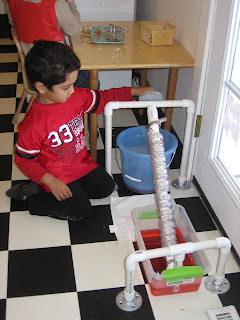


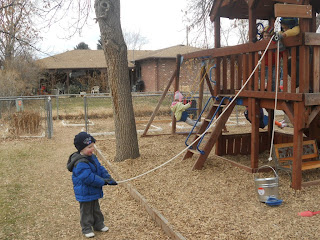
 The children learned to belay, carefully lifting and lowering their load using a hand over hand motion.
 Using the pulley has become a favorite past time in the yard.
 The children have also been experimenting with some compound machines that use pulleys. This simple system uses a crank on a wheel and axle, in addition to a pulley, and gives the children some experience with the uses of a crane and winder.
 Two of the younger children amused me greatly by getting out this material together and using it while they collaborated on a song which included lyrics about "we are the best workers because we work hard all day long." To my amusement, they got the material out together on multiple occasions, always singing the same homage to revered "workers".
 Cranes were invented in ancient
  Additionally, the children have also been experimenting with levers. Levers help to teach students the basic idea of torque (something revolving around a pivot point and the notion that you get a bigger torque by using a bigger force or applying the force further from the pivot point), equilibrium (the idea that under certain conditions objects can be balanced), and the parts of a lever (bar, fulcrum).


 Next week, we will be introducing lessons on magnetism and electricity into the classroom.
