
You can read Longmont Times Call education reporter Victoria A.F. Camron's article about our Launch Day Party here (the online version has an additional really cute photo too!):
http://www.timescall.com/news/longmont-schools/ci_19078490
Monday, October 10, 2011

Sunday, October 9, 2011
Launch Day Video
Here is a link to a great video of our launch party taken by Longmont Times Call photographer Joshua Buck:
http://timescallmedia.com/20111009/multimedia/bloom-rocket-launch/
http://timescallmedia.com/20111009/multimedia/bloom-rocket-launch/
It's Rocket Science!


Today was the first ever Bloom! Montessori School launch party!
Sorry for the crazy formatting... still fighting with Blogger.
For the past few weeks, the children have been learning about forces- gravity, thrust, and drag. To provide students with a concrete understanding of these principles the children have also been constructing their own Estes Generic E2X model rockets. This afternoon marked the long waited date of their maiden flights.
The hobby of model rocketry was born in 1957 in response to the launching of t he Soviet Sputnik satellites and the beginning of the Space Age. Professional rocket engineering companies (like Estes, which began in Denver in 1957) developed quality control procedures which elevated the model rocket motor to a professional level of safety and reliability (in fact, one study found that the safety precautions and operating codes that were put in place have made model rocketry the safest of all hobbies studied, with the exception of stamp collecting).

Still skeptical? "Can preschool aged children construct their
own model rockets?" you might ask. Absolutely. Estes makes a series of E2X rockets which are practically ready to fly. Use glue to attach some plastic fins and a plastic nose cone, and you are ready to launch. No sanding or special tools required! "Can preschoolers understand the scientific principles involved?" Absolutely! One of my favorite moments of last week was hearing a four year old boy, explain to his mother in perfect detail, how the gas moving out the bottom of the rocket would generate thrust to move the rocket in the opposite direction.
So it was, with great excitement and anticipation, that our aspiring engineers conv ened at Sunset Middle School this afternoon. We were fortunate to have perfect weather (after a weekend of cold rain, the winds ceased and the sun came out this afternoon just in time for the launch).
T minus twenty minutes: parents began helping to prepare the model rockets by packing them with wadding paper (to prevent the ejection charges from burning the parachute) and packing the parachutes (it is recommended that this be done as close to the time of the launch as possible to prevent it from sticking).

T minus five minutes: the giddy children and their parents made their way to the launch site, where they received some last minute safety instructions, reviewed the parts of their rockets, and reviewed the forces involved in their flight.
T minus two minutes: the children stood in line, clutching their rockets, awaiting their turn to launch.


5, 4, 3, 2, 1, Lift Off!!
One at time, the children went to stand near the launch pad, begin the countdown, and press the button which would launch their rocket into the air. For our launch, we used Estes A8-3 rocket engines, which generally result in altitudes of 250- 300 feet. There was a lot of cheering, and even a pair of bald eagles which passed overhead, as the rockets went soaring into the air without one mechanical failure (we had a few parachutes that didn't deploy, but not one ignition or ejection charge failure). 


After the launch, the children raced off into the field to collect their beloved model rockets. In one of my favorite moments of the day, a little boy told me "I almost didn't come because I was afraid that the launch would break the fins off my rocket, but I am glad that I came." Not one rocket was lost or damaged as a result of the launch!


 At the end of the party, we celebrated with (what else?) astronaut ice cream and the children received gift bags containing NASA stickers and NASA coloring books. More than one child was overheard asking when they could launch their rocket again, and several parents inquired about where to purchase launch pads and controllers and which retailers were most likely to be open on a Sunday afternoon.
Perhaps the next generation of aerospace engineers were standing in that field this afternoon... or, the next generation of adults who will have fond memories of enjoying model rocketry with their parents at least.
We would like to thank everyone for coming out to celebrate, and sharing in an afternoon that your child will likely remember for the rest of their lives. Your child's rocket is re-useable. If you would like to further your child's exploration and enjoyment of this activity, you can purchase an electrical launch controller (about $20), some wadding paper (about $6), and Estes engines (about $7 for three) from Hobby Town (1935 North Main Street- very knowledgeable and helpful staff), Hobby Lobby, or online retailers.
We would also like to sincerely thank Hobby Town for purchasing our rockets and engines and for their assistance in finding a good launch site, Susan Green (our real rocket scientist!) for supplying the NASA coloring books, and Tobin Munsat and Mei Lai for jumping in and taking the photos that appear in this post (I would have been so sad if we didn't have pictures- thanks for your help and thoughtfulness!).
Want to read more? There is a hysterical, and informative, report on model rocketry entitled Forty Years of Model Rocketry written by the National Association of Rocketry available at http://www.apogeerockets.com/education/downloads/40years.pdf
Saturday, October 8, 2011
Astronomy
 "The Sun, with all the planets revolving around it, and depending upon it, can still ripen a bunch of grapes as though it had nothing else in the Universe to do."
 -Galileo Galilei
I sincerely apologize for the formatting errors in this post. I have been fighting with Blogger for several hours, and I have lost.
The children have been studying astronomy. Astronomy is one of the more difficult units of study for pre-school aged children, because it does not lend itself as easily to concrete experiences with the subject matter. I wanted to begin our unit of study with as concrete an experience as possible, and for that, we needed to schedule a field trip. Now, the idea of undertaking a field trip three weeks into the beginning of the school year might sound daunting to anyone who has taught young children, but one of the virtues of our year-round schedule is that the majority of our students are returning students who attended during the summer. As a result, we are largely able to continue our studies, without requiring a significant re-adjustment or review period at the beginning of each year. We believe that this continuity and sustained academic engagement is an significant benefit to our students.
To begin our unit of study, the children took a field trip to the University of Colorado campus to visit Fiske Planetarium and the Sommers Bausch Observatory. Fiske Planetarium features a Zeiss Mark VI optic star projector, under the largest planetarium dome between Chicago and Los Angeles. Sommers Bauch Observatory features a 24" diameter research grade telescope, 16" and 18" computer controlled telescopes, a solar telescope, giant binoculars, and the world's largest star wheel, beneath a retractable roof which rolls off to expose the public viewing area.
 After a short bus ride to Boulder, we arrived at the planetarium. None of the children had ever viewed a star show at a planetarium before; so the children were very excited. The children were viewing a program entitled Kids in Space.
  The anxious children piled into the planetarium, admired the projection equipment, and took their seats. The children learned why the moon appears to change its shape, took an imaginary trip to each planet in the solar system, calculated how much they would weigh on the surface of the moon, learned about asteroids and comets, and learned about the electromagnetic spectrum and how astronomers use x-rays to learn more about the universe.

Afterwards, the children visited Fiske's interactive science museum. The children were particularly interested in the large meteorite, which they learned had been part of an asteroid that was likely to have been the size of a building and large enough to have volcanic activity. They were also very interested in learning about the dark volcanic maria and prominent impact craters on the moon and they really enjoyed interacting with this sculptural relief of the surface of the moon.

 The children also had the opportunity to view several telescopes, and to learn about their role in the observation of remote objects. They were particularly delighted with the observatory, and the idea that the roof could retract. I only wished that we could return as a group for one of the evening open houses!
At the conclusion of our visit, the children convened on the lawn for a "special treat" of astronaut ice cream, which they enjoyed while reading Max Goes to the Moon, a book in an amazing series written by a former University of Colorado PhD candidate in astrophysics.

 All too soon, it was time for the children to pile back into the bus and return to the school for lunch.
  The children continued their scientific explorations in the classroom, where they used orreries and planet cards to learn about the general characteristics, relative position, and the motions of the planets.
  The children also learned to identify some basic constellations using these constellation matching cards.

 The children ordered planet cards based upon their relative distance from the sun,
  and performed visual matching activities in which they matched identical pictures of planets and objects from the solar system.


Children who can read non-phonetic words, read and matched labels to cards with their corresponding pictures.
 The children used models to understand how the rotation of the Earth on its axis creates the phenomena of day and night.

The children worked on a challenging 180 piece puzzle showing an image of the Earth taken from space.


 Children made labeled diagrams of the solar system,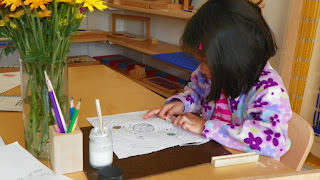
read high-quality, age appropriate literature about astronomy, 

 and even made some books of their own. One girl came up with the idea of using Metal Insets and the circle drawer of the Geometric Cabinet, to produce her own nice little booklet about the solar system,

 which she proudly shared with the rest of the classroom in the Author's Chair (an opportunity for children to read their own compositions to the class).
 An older child, conducted her own research project, in which she read several books about the solar system and produced her own book report. This page reads "Solar is Latin for sun. Everything in our solar system orbits the sun. The sun is a star. "
 In the coming weeks, we will continue our inquiry into astronomy by learning about the history of space exploration. As part of the unit, the children will be learning about rockets and forces. Children will learn about gravity, thrust, and drag. They will be introduced to the personage of Issac Newton and have the opportunity to construct and launch their own single stage model rocket.
and even made some books of their own. One girl came up with the idea of using Metal Insets and the circle drawer of the Geometric Cabinet, to produce her own nice little booklet about the solar system, which she proudly shared with the rest of the classroom in the Author's Chair (an opportunity for children to read their own compositions to the class). An older child, conducted her own research project, in which she read several books about the solar system and produced her own book report. This page reads "Solar is Latin for sun. Everything in our solar system orbits the sun. The sun is a star. "In the coming weeks, we will continue our inquiry into astronomy by learning about the history of space exploration. As part of the unit, the children will be learning about rockets and forces. Children will learn about gravity, thrust, and drag. They will be introduced to the personage of Issac Newton and have the opportunity to construct and launch their own single stage model rocket. We would like to sincerely thank Fiske Planetarium and the Bausch Sommers Observatory for their hospitality and their commitment to educating young people. To learn more about Fiske Planetarium, and upcoming star shows, please visit their website at http://fiske.colorado.edu/
To learn more about Bausch Sommers Observatory, please visit their website at http://lyra.colorado.edu
Bausch Sommers Observatory conducts free public open houses on their observing deck on every Friday night that the University of Colorado is open, beginning at 8pm. We encourage our families to take advantage of this amazing, free opportunity to enjoy stargazing with your child. More information about their open houses can be found at http://lyra.colorado.edu/public/openhouse.html
We would also like to thank St. Vrain Valley School District Transportation for supplying the transportation for our field trip.
Subscribe to:
Posts (Atom)