

 "On an open lot, there's a garden patch grown by children who live in the neighborhood.
A sign on the garden's gate says Children's Garden Welcome!
That means: Come in, please. Listen, see, smell, touch- even taste."
-In the Children's Garden, by Carole Lexa Schaefer, 1994
.JPG)
.JPG) Over the course of our summer program, the children have been learning about the lifecycle of plants, the parts of a plant, the role of insects as pollinators, and about several types of arthropods- including honeybees! Today, the children furthered their learning with an outing to visit the apiary at the Children's Peace Garden in Boulder, Colorado. The children had the opportunity to view a working beehive, taste honey, and put on special child sized beekeeper suits to interact with living bees.
Over the course of our summer program, the children have been learning about the lifecycle of plants, the parts of a plant, the role of insects as pollinators, and about several types of arthropods- including honeybees! Today, the children furthered their learning with an outing to visit the apiary at the Children's Peace Garden in Boulder, Colorado. The children had the opportunity to view a working beehive, taste honey, and put on special child sized beekeeper suits to interact with living bees. Our outing began with a ride on a school bus! The children lined up attentively and rode to Boulder with impeccable manners (they did not require so much as one reminder to lower their voices). In fact, our bus driver, Patrick, remarked to me several times on the exemplary behavior of the students (an occurrence which, much to my pleasure, was repeated several times throughout the day- complete strangers came up to me while we were in the garden and remarked upon the politeness and courtesy demonstrated by the children and incredulously asked me how old they were)! Apparently, the short busses that we normally get were getting some routine maintenance; so, the children were absolutely delighted to get to ride on a full size school bus (for several, this was their first ride on a school bus)!
 After a short ride, we arrived at the Growing Gardens Children's Peace Garden. The Growing Gardens is an incredible, local, non-profit devoted to cultivating community through gardening. They teach environmentally sustainable gardening programs to children and adolescents, as well as horticultural therapy programs for the elderly and the developmentally disabled. They maintain a large organic children's garden and apiary (beekeeping operation) that is visited by 1,500 children annually; additionally, they manage more than 450 community garden plots, administer the Cultiva! Youth Project (an organic market garden maintained by adolescents aged 11-19 who donate a percentage of the yield to those in need and sell the remainder at the Farmers Market), and maintain fifteen active beehives at the site.
.JPG)
We were fortunate to have chosen a beautiful, sunny day for our visit.
 The gardens were bustling with activity; everywhere we looked, people were weeding, pushing wheelbarrows filled to the brim, or resting under the tents with cool drinks. We meandered through the garden until we met up with our thoughtful host, Assistant Director of the Children's Peace Garden, Kirsten Bell and her assistant, Ainsley.
  Kirsten and Ainsley began taking the excited children on a tour of the gardens. The Children's Peace Garden consists of several smaller themed gardens- including a Butterfly/Pollinator Garden, a Pizza Garden (a vegetable garden which contains all of the toppings usually found in pizzas), a lovely gooseberry patch, a hutch covered with grape vines, and numerous plots and raised beds.
.JPG)
 The sun shone brightly on the Flatirons in the distance as the delighted children rambled through the gardens, where they saw a variety of vegetables and flowers.
.JPG)
.JPG) Finally, we made our way out of the gardens and down a shaded path toward the apiary.
Finally, we made our way out of the gardens and down a shaded path toward the apiary.
.JPG) Once the children had assembled, our thoughtful hosts began with a fun activity in which the children learned about and performed a dramatization of the lifecycle of a honey bee.
Once the children had assembled, our thoughtful hosts began with a fun activity in which the children learned about and performed a dramatization of the lifecycle of a honey bee.They children began their "bee life" as eggs laid singly in a cell in a wax honeycomb,
 they hatched into larvae,
they hatched into larvae,  and were fed more than one hundred times a day by busy worker bees.
The larvae undergo several moltings before spinning a cocoon within a cell and pupating. Then, the worker bees cover the brood cells with a wax cap, from which the adult bees must eat their way out
 before emerging and taking their first flight.
 After the lifecycle activities, the children learned about the roles assumed by the different types of bees that live in the hive, their important role in pollination, and about the basics of honey production.
 They also got to examine some hands on bee products- including honeycombs, beeswax, several preserved specimens, and one of the honey supers/frames which the bees build their combs on.
 At last, it was time for the climax of our study of honeybees, the trip to a real, working, apiary hive! Beekeepers wear gloves, boots, coveralls, and a broad-rimmed hat to protect themselves from bee stings. Beekeepers traditionally wear white because bees have difficulty seeing light colors; the light-colored outfit "hides" the beekeeper from the bees.
 In preparation for visiting the hive (and in the most photogenic moment of the trip), our little beekeepers donned these darling miniature beekeeping suits!
.JPG)
.JPG)
 Then, our cute cadre of very excited beekeepers marched off in search of the hive.
 The hive is filled with frames on which the bees build combs. Unfortunately, we were not able to take a lot of pictures here for fear of upsetting the bees, but if you have never seen a working beehive, it is quite an astounding sight (bustling and yet extremely organized). The sheer quantity of bees is staggering and there is the most incredible, audible, humming sound. It is also easy to understand the fascination many people have with these diligent workers and how they have become emblematic of hard work, perseverance, and as a metaphor for ideal civil governance. The hives at the Children's Garden were specially built with large windows on the side which allowed the children to watch the flurry of activity occurring in the hive. The children seemed absolutely transfixed by the activity of the forager bees, busily returning from the garden with pollen and nectar.

.JPG) Afterwards, the children got to examine some of the beekeeping tools, including the smoker. Beekeepers spray smoke into the hives to calm the bees before checking the honeycombs. Kirsten explained that when smoke is sprayed into the hive the bees instinctively begin eating honey (if the hive were on fire this would help them to "stock up"), which causes them to become drowsy and calm.
Afterwards, the children got to examine some of the beekeeping tools, including the smoker. Beekeepers spray smoke into the hives to calm the bees before checking the honeycombs. Kirsten explained that when smoke is sprayed into the hive the bees instinctively begin eating honey (if the hive were on fire this would help them to "stock up"), which causes them to become drowsy and calm.
 Afterwards, Kirsten led the children through the garden to an arbor that was covered with honeysuckle vines. She asked the children what they thought nectar tastes like and why bees like to eat it; then, in a simple, but extremely effective demonstration (which seemed positively inspired to me), she allowed each of them to pick a honeysuckle blossom to sample. Needless to say, the children quickly understood the bees fondness for nectar.
 Then, the children participated in a "pollinator relay." The children took turns pretending to be honeybees, racing through the gardens in search of nectar. The children got to pick a flower and return to the "hive," where they performed a bee dance to indicate where the other bees should go in search of flowers.
 The children were very pleased with their flowers, and I was tremendously impressed with how much botany they had absorbed. Several of them took a few moments to locate the pollen and the various structures of their flower (hopefully, our guests were not too put off by the children's penchant for taking flowers apart- flower dissection is one of their current favorite activities).
 Finally (as one relieved boy exclaimed), the children were treated to a taste of the honey from the hive. Not surprisingly, it turns out that the bees make incredibly tasty honey!
.JPG)
 After all that running, dancing, and "flying" through the garden, it was time to take our exhausted little beekeepers back to the school.

Then, our cute cadre of very excited beekeepers marched off in search of the hive. The hive is filled with frames on which the bees build combs. Unfortunately, we were not able to take a lot of pictures here for fear of upsetting the bees, but if you have never seen a working beehive, it is quite an astounding sight (bustling and yet extremely organized). The sheer quantity of bees is staggering and there is the most incredible, audible, humming sound. It is also easy to understand the fascination many people have with these diligent workers and how they have become emblematic of hard work, perseverance, and as a metaphor for ideal civil governance. The hives at the Children's Garden were specially built with large windows on the side which allowed the children to watch the flurry of activity occurring in the hive. The children seemed absolutely transfixed by the activity of the forager bees, busily returning from the garden with pollen and nectar.Afterwards, the children got to examine some of the beekeeping tools, including the smoker. Beekeepers spray smoke into the hives to calm the bees before checking the honeycombs. Kirsten explained that when smoke is sprayed into the hive the bees instinctively begin eating honey (if the hive were on fire this would help them to "stock up"), which causes them to become drowsy and calm.Afterwards, Kirsten led the children through the garden to an arbor that was covered with honeysuckle vines. She asked the children what they thought nectar tastes like and why bees like to eat it; then, in a simple, but extremely effective demonstration (which seemed positively inspired to me), she allowed each of them to pick a honeysuckle blossom to sample. Needless to say, the children quickly understood the bees fondness for nectar.Then, the children participated in a "pollinator relay." The children took turns pretending to be honeybees, racing through the gardens in search of nectar. The children got to pick a flower and return to the "hive," where they performed a bee dance to indicate where the other bees should go in search of flowers.The children were very pleased with their flowers, and I was tremendously impressed with how much botany they had absorbed. Several of them took a few moments to locate the pollen and the various structures of their flower (hopefully, our guests were not too put off by the children's penchant for taking flowers apart- flower dissection is one of their current favorite activities).Finally (as one relieved boy exclaimed), the children were treated to a taste of the honey from the hive. Not surprisingly, it turns out that the bees make incredibly tasty honey!After all that running, dancing, and "flying" through the garden, it was time to take our exhausted little beekeepers back to the school.Our sincerest thanks goes to our knowledgeable hosts, Kirsten Bell and Ainsley, and Growing Gardens, for providing the children with an amazing, hands-on experience, that I am sure the children will be talking about for a long time to come. For more information about their programs, please visit their website at: http://www.growinggardens.org/.
We would also like to thank our bus driver, Patrick, and the St. Vrain Valley School District Busses and Transportation for making our trip today possible.

 The children have been learning about the different parts of a plant, including the different structures present in leaves, and we have been discussing how plants make their own food through the process of photosynthesis. Photosynthesis begins when light is absorbed by proteins that contain
  This is an incredibly simple lesson to set up and 2-6 year old children can make prints independently if you supply an hourglass or simple method for ensuring that the paper is exposed to adequate amounts of sunlight (we achieved good results with a 3 minute egg timer). Here is how the lesson looks on the shelf.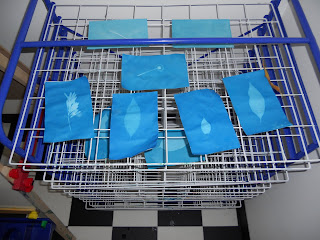

 Then the children develop their prints by rinsing them in water (where the


