
Whether it means carrying hyacinths around the classroom and sharing their delicate fragrance with your friends or spending the weekend pouring through seed catalogues, we all find ourselves dreaming of Spring.
This weekend, we formalized plans for our edible classroom, the Bloom! Potager. In March, the children will begin starting seeds indoors to transplant once the danger of frost has finally passed. Our goal is to give the children a better understanding of the natural world (botany, the life cycle of plants, a garden ecosystem, composting/decomposition), encourage children to eat a healthy diet rich in fruits and vegetables, create meaningful experiences between children and food, and expose them to the pleasures of gardening.
We selected diverse vegetables that we thought the children would really enjoy- including a lot of vegetables with really vibrant colors, foods that could be included in traditional Montessori food preparation exercises, and small vegetables (baby carrots, grape tomatoes, miniature varieties of peppers, cucumbers, and beets), that would be perfect for an individual snack!
The gardens will be grown without the use of any synthetic pesticides and fertilizers. The seeds we will use are primarily organic, heirloom varieties that we purchased from Seed Savers Exchange, a lovely non-profit in Iowa that is devoted to increasing genetic biodiversity in the food system by helping to save the world's diverse, but endangered, garden heritage from homogenization by seed conglomerates. They operate the largest non-governmental seed bank in the United States where they permanently maintain thousands of rare and unique vegetable varieties from around the world- more than 25,000 endangered vegetable varieties! Most of the seeds were hand carried to North America by immigrants and passed along to their ancestors.
Who knows, maybe Maria Montessori had some of the same varieties in her own garden!
For more information about Seed Saver's Exchange, please visit their website at:
Here's what the children will be growing in the Bloom! Gardens this Spring:
"Green" Beans:
-Climbing French: Classic green beans! The most widely grown climbing French bean in the 1930's
-Pencil Pod Golden Wax Beans: An beautiful translucent stringless bean, introduced in 1900
-Red Swan: A stabilized cross between a purple snap bean and a pinto bean! Dusty red rose colored!
-Sultan's Golden Crescent: A beautiful, curly, translucent, stringless bean that is almost extinct.
We can't wait to see the children picking green beans for snack! Hopefully, the vibrant colors will entice even the most reluctant eaters!
Other Beans:
-Hidatsa Shield Figure: There are Slow Foods Arc of Taste beans raised by the Hidasta Indians
-Tiger's Eye: These hail from Chile or Argentina, beautiful mottled appearance
We foresee lots of bean shelling!
Beets:
-Cylindra: Tiny carrot shaped beets that resemble red carrots. Sweet, easy to peel, perfect for snack time!
-Chioggia: Beautiful red and white concentric rings. Came from Italy in the 1840's
Carrots:
-Dragon: Tiny, refined purple carrots! Does that sound like a great snack food or what?
-Paris Market: Really tiny, red-orange carrots.
-Scarlet Nantes: Yummy baby carrots!
Cucumbers:
-Crystal Apples: Apple shaped cucumbers from New Zealand. Great for fresh eating at snack time with dip!
-Parisian Pickling: Known in Europe as Improved Bourbonne, used for making cornichons and gherkins!
We are sure the children would love doing some pickling activities!
Melons:
-Delice de la Table: French heirloom from 1885- almost extinct, very sweet, translates as "delight of the table"
-Prescott Fond Blanc: French melon from 1850- beautiful warted skin and an incredible fragrance when ripe
Melon balling activities!
Onions:
-Borettana: Italian cipollini heirlooms! Great for pickling and kabobs!
Peas:
-Dwarf Gray Sugars: Introduced in 1892- stringless, beautiful purple blossoms!
-Green Arrow: Standard English peas!
We know the children will love wandering through the garden picking the prolific sugar snap peas, and shelling proper English peas!
Peppers:
-Buran: Sweet, bright red, glossy, Polish heirloom, bell peppers
-Joe's Round: Originally from Italy, brought to the US by the Sesito family of NY. Sweet 3/4" round peppers (almost like a grape tomato)- perfect for snack time!
Squash:
-Galeux d' Eysines: Introduced in France in 1996- sweet, moist, and covered with beautiful warts
-Long Island Cheese: East Coast heirloom remembered for great squash pie!
-Pumpkins: Duh!
Radishes:
-Early Scarlet Globe- Beautiful, bright red radishes!
-French Breakfast: Oblong and blunt, rose scarlet with a white tip (like a beautiful carrot!). Perfect for snack!
Tomato:
-Currant Sweet Pea: Very prolific! Excellent clean tomato flavor!
-Italian Heirloom: Beautiful heirlooms from Italy. Easy to peel, great for canning!
Watermelon:
-Golden Midget: Golden yellow plants and fruit with very sweet salmon flesh
-Moon and Stars: Oval fruits covered with bright yellow stars and one large moon.
The children will also be growing a small herb garden and a garden with some heirloom flowers (including a large number chosen to attract butterflies- which the children will be hatching!).
We can't wat to see the children wandering through the gardens, stuffing their mouths with fresh vegetables that they grew themselves!


 During lunch, the bunny decided to keep the children company. She found a shady spot under the tree (right in the middle of the yard, 25 feet from the patio where the children were eating) and munched on some fresh grass while the children finished their lunches. Afterwards, she returned to her den in the mulch pile, climbed inside, and has not been seen since.

 The
The 


 This week marked the first harvest from the school's vegetable garden. These beautiful French
  Upon returning to the classroom, the children carefully cleaned them (remembering the technique demonstrated by "Farmer Mike"), and walked around munching on them as if they had been entrusted with a cache of lollipops.


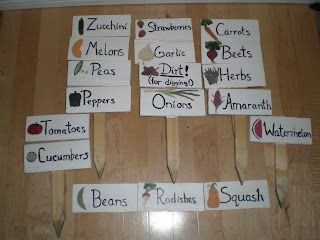
 and one of my favorite language lessons: writing the garden. In Montessori classrooms, children repeatedly trace sandpaper letters to learn the correct formation of letters. As a result, once they acquire the finger strength and fine motor coordination necessary for handwriting, they usually explode into the "spontaneous" ability to write letters, numbers, and words. This is very exciting for the child! Upon discovering that they can write, most children desperately want to write everything (names of their friends, the menu from lunch, letters to their parents, etc). This morning, one boy appointed himself the task of making his own signs for the garden and walking outside to stake them in their correct spots in the raised beds. I must say, they turned out quite nicely.
 Later, we went out as a group and planted four kinds of heirloom beans- some pretty


 Upon their return from Spring Break, the children were delighted to find that the seeds they started had begun to germinate.
 Today marked the children's first day in the newly constructed garden! Young children are
 .JPG)
.JPG) Children are consummate naturalists! The children collected some (57!) earthworms. They measured the worms and closely observed the parts of the worms, how they moved, and their reaction to light. Many of the children wanted to feel the worms wriggle in the palms of their hands, while others preferred to observe at a distance. After a bit, they released the worms back into the plot and watched them scrunch back into their burrows.
Children are consummate naturalists! The children collected some (57!) earthworms. They measured the worms and closely observed the parts of the worms, how they moved, and their reaction to light. Many of the children wanted to feel the worms wriggle in the palms of their hands, while others preferred to observe at a distance. After a bit, they released the worms back into the plot and watched them scrunch back into their burrows.
.JPG)
.JPG)

.JPG)
.JPG)
 Later, the children learned about composting and christened the new bin with it's first load of lunch scraps.
 .JPG)

 We have been very excited about creating a gardening space at Bloom! We feel that hands-on, experiential learning about photosynthesis, composting, and biodiversity are extremely important for children this age. We believe that these experiences help children to try new foods, assist children in developing a more sophisticated palate, provide them with a practical understanding of where their food comes from, and provide them with nutritional habits that will set them up for a lifetime of physical well being.
 We also built a small tool shed to house the children's gardening tools.
  Finally, I enlisted the help of my talented assistant Katie, who willingly spent some of her Spring Break creating these hand-painted signs for the garden.
 For more information about the importance of nature to children, see Last Child in the Woods by Richard