This afternoon, the children were treated to one of the highlights of our summer arthropod unit, a visit from the Butterfly Pavilion. The Butterfly Pavilion has the distinction of being the nation's first stand alone non-profit invertebrate zoo. It features more than 1,600 free flying butterflies, more than thirty five species of arthropods, and a tide pool showcasing other invertebrates.
For our classroom, Dorothy, a volunteer with the Butterfly Pavilion's acclaimed Outreach Program, presented their Summer Bug Safari program to the children. Spirits were high all morning in anticipation of the impending visit. When it was time to gather as a group to view the insects, the children sat with rapt attention as Dorothy reviewed the basic characteristics of all arthropods, explained the difference between carnivores, herbivores, and omnivores, and explained the terms habitat, decomposer, and scavenger. Then, she showed the children some amazing examples of preserved exoskeletons.
 The presentation began with a visit from a reticent hermit crab,
 followed by the largest centipede I have ever seen.
 Then, the children were treated to a visit from a gregarious millipede with forty legs,
 and several Madagascar hissing cockroaches. The children were allowed to touch the cockroaches, to feel their hard exo-skeletons and hear the unique hissing sound they produce by forcing air through their spiracles.
 While our study of arthropods concentrated heavily upon insects and their important role as pollinators, the predictable highlight of the presentation is always the arachnids. The children were treated to an up-close view of a Black Widow Spider and a scorpion- the latter was met with stifled gasps and a refrain of "I've never seen a real scorpion before," (to which our amused and gracious guest guest responded "How lucky that I brought one then").
 Finally, it was time for the appearance of Rosie, the Chilean Rose Tarantula (or one of her numerous doppelgangers), the star of the show.
 Ask any child who has been to the Butterfly Pavilion before for the highlight of their trip, and you are likely to get one answer: holding Rosie the tarantula. Unfortunately, when the Butterfly Pavilion came to the school last year, Rosie was in the process of molting and feeling too temperamental to be safely fondled by a classroom of preschoolers; this year, we were in luck- Rosie was amenable.
 Dorothy gave the children some quick instructions as to how to safely hold Rosie and tried to alleviate any fears the children might have had.
 Then, to the great surprise of our guest, every child in the classroom willingly invited Rosie to crawl across their little palms and give them an arachnid "high five" with her furry little legs.


At the end of the presentation, our thoughtful guest took a few moments to ask me about the school and inquire into Dr. Montessori's theories about behavior and guidance. "The children were so well behaved," she remarked (to my visible delight). "Dr. Montessori believed strongly in the importance of instructing children in grace and courtesy," I explained proudly. We spent a few moments discussing how little attention is often given to these skills, despite the fact that most research shows that impulse control, the ability to delay gratification, and teaching children pro-social behaviors are among the most important skills we teach them, and the very foundation of future academic success.
For my part, I couldn't help but think, the presentation embodied the ideals of a Montessori education: our job is to present the world to children in a way which will arouse their interest, curiosity, and admiration.
We would like to sincerely thank Dorothy, our kind and knowledgeable guest, and the Butterfly Pavilion for bringing this amazing program to our school. For more information about the Butterfly Pavilion, please visit their website at: http://www.butteflies.org/.


.JPG)
.JPG)


.JPG)
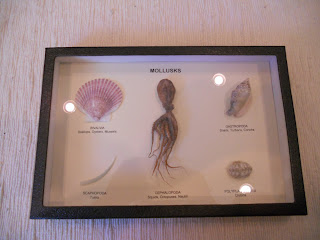
.JPG) The children were very interested in the classroom shell collection, in particular. Many of them were happily
The children were very interested in the classroom shell collection, in particular. Many of them were happily  Needless to say, the aquarium is very interesting to the children. At practically all times of day, one or more children can be seen crowded around, carefully observing the activity in the tank. I have been tremendously impressed with the quality and exactitude of some of their observations (one four year old boy remarked that the cleaner shrimp liked to stay in the cave and asked whether it might be more active at night, when it was dark- a quick flick of the light switch in the tank and he was able to both test his hypothesis and get a hands on demonstration of the term "nocturnal"). I am very excited about this new addition to our classroom (and happy to have found more interesting snails!).


.JPG)