


Montessori taught teachers and students alike to take joy in carefully observing and experimenting with natural phenomena. As a scientist, she strongly believed that reality is such an object of wonder and awe in and of itself that it requires little embellishment, and that children instinctively (and empirically) prefer purposeful investigation of reality to fantasy and pretend play (for example, a Montessorian might argue, there is no inherent reason why teaching a child to appreciate the fractal/recursive nature of a tree, the way the water cycle recycles water that has been on the Earth for millions of years so the rain drops falling in the forest might have been consumed by a dinosaur millions of years ago, the clever ways in which the plants lure insects to pollinate them, that the trees in the forest can make food from the light of a distant star, that the water in the forest can be transformed from a liquid, to a solid, to a gas, or about the amazing variety of animals that make their home in a forest should be less interesting to children than an invented story about garden gnomes who live in the base of trees and drink rainwater with fairies). When Montessori speaks about "Cosmic Education" this is what she means; she implores us to teach children about the world, and their place in it, with a sense of wonder, amazement, and reverence which is appropriate to the amazing phenomena which we are explaining. But, I digress... In any event, it is difficult to imagine a more fitting field trip for Montessori students (and teachers!) than a trip to the Colorado State University's Little Shop of Physics laboratories in Ft. Collins, Colorado.
This year, we were very fortunate to have been invited by the Little Shop of Physics to attend one of their open houses for schools. The Little Shop of Physics is CSU's award winning hand's on science outreach program. The program was founded by CSU Undergraduate Physics Instructor Brian Jones and is operated by a committed group of science educators, physics professors on sabbatical, and science students at the university. The program is funded by private donations and through a grant from the National Science Foundation. They are passionately committed to their mission of travelling around the state showing students that science is fun, interesting, and something that anyone can "do." One of the major differences between the Little Shop of Physics and other science outreach programs is that they do almost nothing in the way of "presentation," everything is experimental. Their motto is: "We don't show science, we help them "do" science." I am not certain a more Montessori-esque statement has ever been uttered by a group of physicists!
Visiting the Little Shop of Physics consists of turning the children loose in introductory physics laboratories for 90 minutes. Imagine four laboratories replete with nearly 100 experiments in each (about 400 total- spinning fluid tanks, tornadoes, clouds in bottles) and staffed by members of their organization. The rooms are roughly themed into a lab containing motion experiments, a darkened lab of experiments best performed in the dark, a lab of optical and acoustic experiments, and a lab of magnetic and energy experiments. The children pretty literally race from room to room choosing what interests them with ample time to explore and repeat those which most capture their attention. Hmmm, sounds a little like a Montessori classroom!
While I had no doubt that the children would enjoy themselves thoroughly, one thing did concern me slightly about the trip- bathrooms! Fort Collins is about an hour from Longmont, so the trip would require a long bus ride for our young scientists; however, when I asked the children if they wanted to go to the university to "help some real scientists with their experiments" they were so enthusiastic, I knew it would be worth the added difficulty. So, after briefing the children about the importance of going to the bathroom before leaving the school, we set out on our journey to Fort Collins in their beloved big yellow school bus. The children were consummate travelers; to the bus driver's amusement, they contented themselves with singing "The Yellow Submarine" (apparently their school bus song of choice), "Jingle Bells," and "Mississippi Hotdog" (the children who take Suzuki violin lessons decided to perform these complete with beautiful martele bow strokes on their imaginary violins!), while a few children who recently learned to read two digit numerals entertained themselves with reading the speed limit and street signs on the drive.
Once we arrived at CSU, the children made their way through the campus until we found the Physics building. We spent a few minutes admiring the pendulum in the entryway as a long procession of children made their way to the restrooms. Then, we met our host, Nisse Lee, the program's coordinator, and the jubilant children made their way to the laboratory.


 Once inside, the children received a brief orientation. Nisse explained that all of the experiments were available to them. She also demonstrated one of the experiments: In this experiment, the subject (Josh) volunteered to catch a graded block dropped above his head. His reaction time was noted. Then, the experiment was repeated with his vision impaired with darkened goggles. The difference in his reaction time was noted.
 Finally, the excited children were dismissed and permitted to select activities for themselves. Imagine renting out an entire science exploratorium for an hour, taking your child and eleven of their closest friends, and turning them loose with the entire place to yourselves- that would be a pretty good description of the experience. All around the room were small groups of children, simultaneously fixated and elated, as if they were miniature Feynmans taking delight at throwing their legendary cafeteria plates into the air. It was very interesting to note which activities really held their interest. After a few minutes of racing around and really investigating everything in the room, there were several favorites which really captured the children's sustained interest.
 It is impossible for me to name, or even remember all of the experiments that were available (and the pictures from the ones in the darkened room did not come out very well). For example, the experiments included levitating beach balls, balloons, and other objects,
 suspending a long loop of string in air, compressing a bag containing foam balls,
 creating tornadoes,

 and experimenting with centripetal force.
 There were bottles containing substances of different densities to be combined,


 and vibrating tables (a huge hit- one of the experiments that many of the children sat with for nearly twenty minutes) to explore.
  There were balls to spin on a turntable (another huge hit),

 and vortex tunnels to be explored.
  There were also games to be played- like catching a heavy ball that is rolling in a straight line by rotating the table.
 There were "paintings" to be made using heat sensitive material and hair dryers and pendulums whose movement was affected by magnets on the bottom of the pendulum and magnets with different polarity attached to the bottom of the box.

 There was music to be "played" on oven-rack xylophones (listening to the vibrations travel through the strings).


 and a host of optical illusions and experiments.
 There were turbines to be turned using a hair dryer which generated the electricity required to light a Lego house.
 There was an entire room of experiments to be performed in the dark- including numerous plasma balls, a glow in the dark vortex funnel, experiments with different colors of infrared light, and painting with sunscreen under a UV light (one girl spent nearly 20 minutes doing this!).
 There were wrenches of different lengths to be played like windchimes, and a host of different acoustic experiments.

 The children also played at creating a standing wave in a spinning chain.


 And, as if that was not sufficient to ensure an enjoyable day, our hosts had one more surprise in store for the children... an entire room of magnet works!


To conclude our visit, our hosts gave the children a parting gift of some Pulfrich 3D glasses and demonstrated the Pulfrich Effect for the children (in which a filter placed over the eyes causes you to interpret the lateral motion of a swinging pendulum as having depth). The Little Shop of Physics website contains additional animations that the children can view using their glasses.
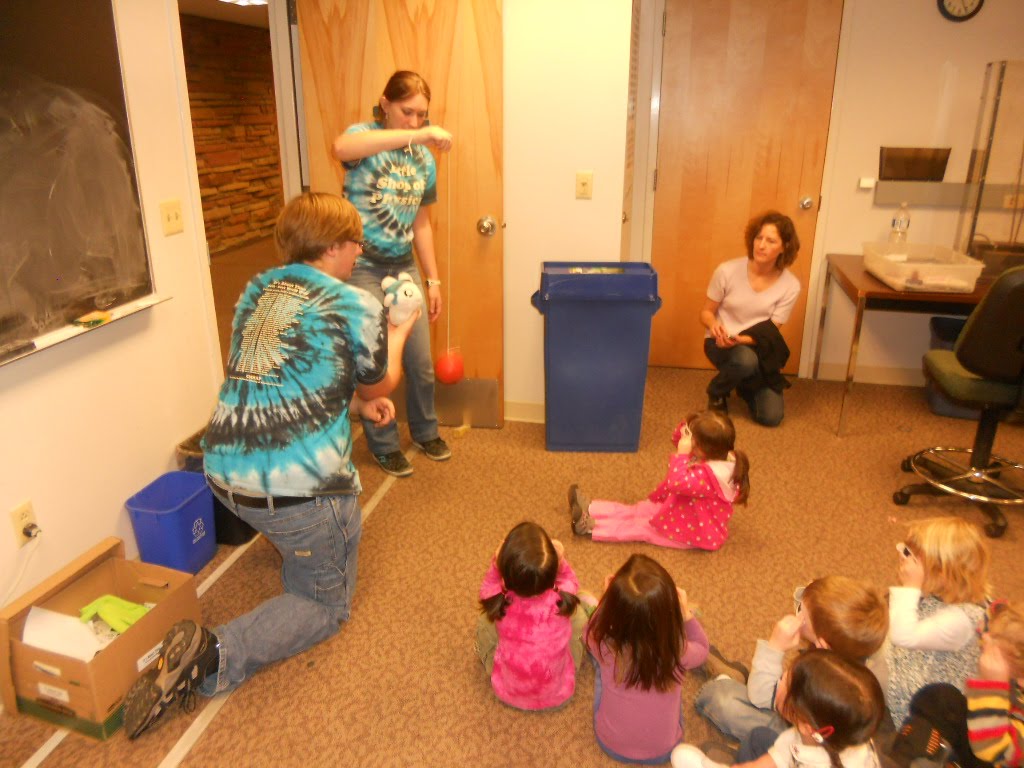

 After an exciting morning, the tired children boarded the bus for a nearly silent drive back to the school (a full quarter of them fell asleep). For days after the trip, on the playground, the children pretended to be "going to the university" and pretended to be "scientists" building experiments. I know that the experience definately peaked their interest in higher education and their adoration of scientists, although it seems to have left them with a very different impression of physics then most adults have- that physics students (and maybe college students in general) spend all of their days in laboratories "working" with interesting experiments just as they did. Perhaps there is a future Richard Feynman in our ranks!


 3) Then, our young renaissance scientists interact and perform experiments, with working models of simple machines. They replicate some classic experiments and inventions, gain exposure to the scientific method, and manipulate materials that enhance their three dimensional visualization skills and their understanding of the position and motion of objects (they ways in which objects move, the ways in which applying a force changes the motion of an object, and that under some conditions an object can be balanced).
 4) Finally, the children gain an appreciation for the history of engineering, physics, and applied mathematics. Specifically, they are introduced to the personages of Archimedes, Leonardo


 And, they have used architectural blocks to understand and appreciate the uses of simple machines, and their application in the construction of of architectural marvels. These are some of my favorite lessons in the classroom because of the way in which they really take advantage of the mixed age group (with the older children delighting in being able to assist the younger children in building the complex models).


