Showing posts with label physical science. Show all posts

Tuesday, February 1, 2011

Magnetism

When I give tours of the school, I am often asked about science education for preschool children. Although there seems to be an acknowledgement that children are nascent scientists (in fact, a recent study by the National Science Foundation described them as "scientists in waiting... naturally curious and actively involved in exploring the world around them"), many parents are uncertain of how to expand their child's ability to think in ways which follow the scientific method and how to provide opportunities for children to conduct inquiries which contribute to the acquisition of scientific knowledge and nomenclature. So you can imagine the skeptical looks I get when I tell them that the best method I know of for doing so was invented more than one hundred years ago.
I have mentioned before that Montessori materials isolate one concept to brings forth the idea to the child in a concrete, hand's on manner in which the child can be at once scientist and explorer, and discover the concept for his/herself as an active participant in the learning process. The Montessori guide is indispensable in this process, but not as a teacher or a lecturer, so much as a facilitator who presents well timed opportunities for intellectual investigation that dialectically advances the child's understanding of the world. The main responsibility of the Montessori guide is to prepare the environment with the correct materials and provide the expert scaffolding (well timed interventions in the form of stimulating questions, hints, cues, and motives) that helps the child reach a higher level of thinking.
Few things illustrate the dialectical progression (how different concerete, sensorial experiences build upon each other to allow the child to acquire more sophisticated knowlege) of concepts better than science units.

For the past month, our science shelves have been stocked with lessons presenting basic concepts in magnetism.


A Magnetic Sorting Lesson allows the child to independently discover that some materials are attracted to a magnets and develop their conceptual sorting skills (the ability to form groups of objects based upon a single, common, objectively determined attribute from a diverse collection of objects- a complex skill that Piaget and Vygotsky famously believed children could not accomplish until early adolescence when they had achieved a sufficient understanding of the relationship between category and subcategory) as they sort a collection of objects into things that are magnetic and things that are not magnetic.

Once the concept was understood, the children used the concept to make some interesting insights which went beyond the scope of the lesson. Some children experimented with magnets in water (they were unsure whether the force of magnetism could go through water). Another girl spontaneously invented the classroom stud finder when she discovered that some part of walls were attracted to the magnet while others were not.

Another girl came up with the idea of producing this lovely book about magnetism.
After that, the children used a magnet to separate iron filings from other dry mediums, using these commercial materials


and by mixing sand and iron filings together and using a bar magnet to separate them.


Now that the basic idea was clear, children were given materials which enabled them to visualize magnetic fields by seeing how the iron filings line up along the lines of force of the magnetic fields.

They were also given materials that enabled them to see that the magnetic force surrounding a magnet is not uniform. There is a great concentration of strength at each end (at the poles) and a very weak force in the middle (demonstrated by dipping a cylindrical magnet in a tube containing iron filings- the filings accumulate at the ends while very few adhere to the center).

An assortment of magnets led the children to three other important discoveries: all magnets have two poles (north and south), opposite poles attract and like poles repel, and magnets can differ in strength.
The children also applied their understanding of polarity to match magnet configurations to pattern cards (putting opposite poles together when they wanted them to attract and like poles together when they wanted them to repel).


Then the children made their own compasses (out of corks, magnetized needles, and bowls of water) to understand that the needle of a compass is magnetic and to see how they respond to the bigger magnet that is our planet.

Then, the children learned about and visualized the Earth's magnetic field using a globe with a magnetic dipole.


Once the children understood that the needle of a compass responds to the Earth's magnetic field, they were ready to learn how to use compasses. They particularly enjoyed using them to label the room with its corresponding directions (they delight in getting this out and doing it several times a day). One child independently reasoned (based on her knowledge of polarity) that the Earth's North Pole must actually have the polarity of a south magnetic pole since it attracts the north pole of the compass needle!The children also examined compass roses on maps, created some compass roses, and discussed the way that a compass might be used as a literary trope.

And, of course, the children enjoyed relaxing and reading some quality non-fiction literature about magnets and compasses.


Over the next few weeks, we will be introducing lessons on electricity into the classroom.
Thank you to my mentors: Anna Applebaum (of Mapleton Montessori) for the idea of the Magnetic Sorting Lesson, Patty West (of Boulder Montessori) for teaching me how to develop physical science units for children in this plane of development, and Susan Stephenson for the Sand/Iron Filing Sorting lesson.

Saturday, January 8, 2011

Simple Machines- Part Two


The children have been continuing their study of simple machines. In a Montessori classroom, children are given lessons independently (sometimes with a few other children watching, who have been shown how to be a "quiet observer," who watches the lesson without interrupting in any way). During the lesson, the children are shown how to gather the needed materials, carry out the exercise, repeat as many times as desired, and to put the material away. Once the child has been given a lesson on the material, they are afforded the opportunity to work with the lesson independently (and get it out at will).

Each lesson contains one conceptual "key; " it isolates one important point, satisfying the child's knowledge, and bringing forth one idea or natural law through a concrete, hands-on activity. The lessons are simple, related to the child's needs, fitted to her age and abilities, and easy enough that she can do them herself.

Science lessons are no different. They are not small or large group activities, to be performed and directed by an adult and watched by the children. They are independent lessons which permit the child to be the scientist and explorer, and to discover principles for herself, which she does by repetition. At all times, the independent child is an active participant in the search for understanding (inquiring and discovering for herself), not a passive consumer of pre-formulated information.

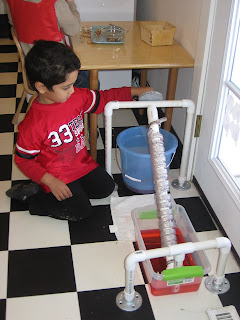
As part of this unit, the children have been investigating the many varied uses of screws. In addition to practical life lessons in which the children use screw drivers, hex drivers, and allen wrenches, they have also been learning about the historical use of screws to raise water, using a model of an Archimedes Screw.

The invention of the Archimedes Screw, or screwpump, has been attributed to Archimedes (a student of Euclid)in the third century. It was used to lift water from low lying bodies into irrigation ditches. These ancient machines are still in use today; in 2001 they were successfully used by engineers to stabilize the Leaning Tower of Pisa, they have been used to reclaim land from under the sea in the Netherlands, and they are commonplace in many modern sewage treatment plants.

The children were very interested in this invention and enjoyed hearing stories about Archimedes and about the Siege of Syracuse.

It is not uncommon for Montessori students, after getting a work out independently and repeating it as often as needed to fulfill their needs and satisfy their curiosity, to spontaneously create something new using the information they have learned- a story, a conversation, a drawing, or to share their new accomplishment and validate their own growth by teaching another child to do the work. The way in which the mixed age group accommodates this natural desire to create and to share information with others, it one of the method's most important achievements. To the observant guide, these act of creation demonstrate the ways in which the child has assimilated the new information into their conceptual scheme; additionally, it is quite a delight for the teacher to observe- because it occurs spontaneously, unprompted, and the form in which it appears can differ markedly.

For example, after working with the Archimedes Screw and looking at some of the classroom books, one girl took it upon herself to create this clever diptych of Archimedes. She brought the work over to show me and explained that she had drawn Archimedes as a child and Archimedes as an adult "because all people were a baby and a child once, you know." What a lovely portrait, and a nice consolidation of what she had learned about Archimedes, history, biology, and the lifecycle of a person.
In addition to learning about screws, the children have been investigating pulleys. They have been performing experiments with fixed pulleys and block and tackle hoists (a system of two or more pulleys with a rope threaded between them) to learn that pulleys redirect force (you pull down on the rope, but the pulley pulls up on the load) and that a single pulley will not amplify the force (you will have to pull just as hard to lift the load with the pulley) but multiple pulleys (like the block and tackle system) provide mechanical advantage. The children also had the opportunity to experiment with different methods of rigging a tackle.
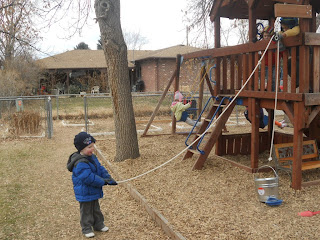
After the children had been working with the classroom models for a few days, my husband when out to the yard one afternoon and put up a pulley in the play area. The children peered through the glass and excitedly watched him at his work as they finished their lunches. "He has a surprise for us," one boy told me confidently. Afterwards, they raced outside to take turns using it as a fixed pulley and as a block and tackle hoist.

The children learned to belay, carefully lifting and lowering their load using a hand over hand motion.


Using the pulley has become a favorite past time in the yard.
The children have also been experimenting with some compound machines that use pulleys. This simple system uses a crank on a wheel and axle, in addition to a pulley, and gives the children some experience with the uses of a crane and winder.

Two of the younger children amused me greatly by getting out this material together and using it while they collaborated on a song which included lyrics about "we are the best workers because we work hard all day long." To my amusement, they got the material out together on multiple occasions, always singing the same homage to revered "workers".

Cranes were invented in ancient Greece. The earliest models were powered by beasts of burden, but the Romans developed more powerful cranes which employed the use of human treadmills like this reconstruction from Bonn, Germany.

Additionally, the children have also been experimenting with levers. Levers help to teach students the basic idea of torque (something revolving around a pivot point and the notion that you get a bigger torque by using a bigger force or applying the force further from the pivot point), equilibrium (the idea that under certain conditions objects can be balanced), and the parts of a lever (bar, fulcrum).
We have several models of levers in the classroom, including one in which the children can create class two levers (where the fulcrum is at the end and the applied force is at the end), but the universal favorite of the children is this lever in which they experiment with lifting a fixed load of five washers. The children begin with the fulcrum in the middle of the bar and hypothesize how many washers must be applied to the force side to lift the load of five washers (6). Then, they experiment with moving the fulcrum closer to the load and discover that it requires less force to lift the same load (4). By changing the position of the fulcrum, and using such a simple system for comparing force (quantities of washers rather than known masses), even children with limited mathematical knowledge can readily note the force amplifications and understand the relationships among the different distances and forces.
I was particularly pleased when, after a few minutes of working with this material, one kindergarten age girl informed me that she had noticed that when nothing was on it, the bar only balanced when the fulcrum was placed in the middle of the bar. She was very excited about showing her discovery to the other students. These "aha moments," and the thrill of discovering something for herself through observation and experimentation, are lost in group settings where teachers present information to children, rather than creating the conditions where they can come to the same conclusion through their own mental efforts.


Once the children had a good understanding of the idea of torque and equilibrium, it was time to bring out the balance scale and introduce the idea of measuring using known masses.


The children have also been busy applying their knowledge about simple machines through conceptual sorting activities like this one. In this lesson, they examine pictures of simple machines that can be found in their homes and environment and sort them based upon the type of simple machine represented. This is a pretty abstract (and challenging) task for a three- six year old!

We have also been studying the art of Leonardo Da Vinci; many of the children made Inventor's Journals featuring tracings and sketches of simple machines in the style of Da Vinci's journals.


The children were also enamored with David Macaulay's book The New Way Things Work. They spent many an afternoon leafing through the pages of the book, examining simple machines, and it afforded the inspiration for many depictions of "pirate ships" that had lever "ship shakers" like those Archimedes is said to have designed for the Siege of Syracuse.

Next week, we will be introducing lessons on magnetism and electricity into the classroom.