
 Of all the genera in the Fungus kingdom, perhaps none is more beloved than Saccharmyces Cerevisiae, otherwise known as baker's yeast. Today, the Children's House was filled with the enticing fragrance of freshly baked bread as the children continued their study of Fungi by learning about the magic of yeast and by producing lovely white whole wheat boules.
 I have always loved things that have a personal history (my wedding ring is an estate piece, my favorite seeds were saved by relatives or come with interesting anecdotes about the people who developed them or transported them to North America, and my favorite variety of coffee was stolen from a Paris garden and smuggled to Brazil in bouquet given to a young man by his lover). So, you can imagine how enamored I am with our first class "pet."
The children have begun caring for our own yeast colony- this Sourdough Starter (a piece of dough in which the yeast is continually reproducing thanks to being "fed" a daily ration of flour- this is responsible for the distinctive flavor of sourdough bread) that we purchased from King Arthur Flour Company (one of our favorite companies and the best flour you can buy!). This sourdough is descended from a starter that has been lovingly nurtured in New England since the 1700s.

Sourdough starter is undoubtedly the perfect first pet- low maintenance, quiet, and it smells good! However, it does need to be fed and watered daily (a chore that the children love to perform!). One of the things I really like about incorporating this into a unit on Fungi is that it helps the children to really appreciate that Fungi is alive and to understand one of the principle differences between Fungi and Plants (which can be difficult for them to grasp- many students intially guess that mushrooms are plants)- Fungi are unable to produce their own food and must obtain their nutrients by absorbing them from other sources.
 In order to help the children fully appreciate the many virtues of our new class pet, I convinced the best bread baker I know, my husband, to take a day off of work and teach the children to make artisan boules. The children were very excited to learn that the holes in bread were the result of carbon dioxide bubbles released (burped!)by the yeast as they consumed (gobbled!) the sugar in the flour.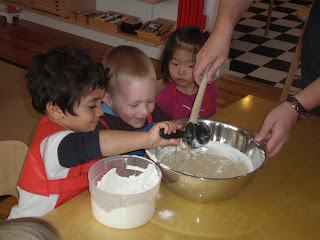
.JPG)
 After two hours of rising, the dough was ready to be turned (kneaded). While some were initially apprehensive about the stickiness of the dough, by the end, everyone was happy to help (and some couldn't help but take a premature taste).
.JPG)
.JPG)
.JPG)
.JPG)
By nap time, we had nine perfectly shaped mini boules.
.JPG) The children were awakened from nap with a bright, sunny afternoon and the enticing aroma of freshly baked bread. They excitedly enjoyed their special treat of warm bread at a table strewn with crumbs. Then, as the perfect conculsion to a fun day, they took home their own little boule to enjoy with their family over dinner.
The children were awakened from nap with a bright, sunny afternoon and the enticing aroma of freshly baked bread. They excitedly enjoyed their special treat of warm bread at a table strewn with crumbs. Then, as the perfect conculsion to a fun day, they took home their own little boule to enjoy with their family over dinner.
Bon Appetit! (and, thanks Josh!)

.JPG) Our unit on Fungi continued this week with Mushroom Slicing, a twist on a classic Montessori Practical Life exercise. The children enjoyed carefully cleaning and slicing fresh Button Mushroom caps.
Our unit on Fungi continued this week with Mushroom Slicing, a twist on a classic Montessori Practical Life exercise. The children enjoyed carefully cleaning and slicing fresh Button Mushroom caps..JPG)
.JPG)
.JPG) Later, the children enjoyed a special treat of Spinach and Maitake Mushroom wontons prepared by my assistant, Katie. One boy reported that they "taste like chicken," an idiom I had not expected from a two year old. Without exception, every child took a second helping and begged for more.
Later, the children enjoyed a special treat of Spinach and Maitake Mushroom wontons prepared by my assistant, Katie. One boy reported that they "taste like chicken," an idiom I had not expected from a two year old. Without exception, every child took a second helping and begged for more.
.JPG)
.JPG)

 Their interest in Fungi even spilled over to outside play time. One boy came running toward me yelling excitedly, "Fungi, teacher! There's Fungi!" I followed him to find lichens growing on some of the trees and rocks in the yard. How lucky!

.JPG)
.JPG)


 Finally, the children celebrated the culinary virtues of fungi, by making and enjoying a special snack of mushroom risotto. There were more than a few fans of the earthy flavors in this classic comfort food!
.JPG)
.JPG)