

 When I give tours of the school, I am often asked about science education for preschool children. Although there seems to be an acknowledgement that children are nascent scientists (in fact, a recent study by the National Science Foundation described them as "scientists in waiting... naturally curious and actively involved in exploring the world around them"), many parents are uncertain of how to expand their child's ability to think in ways which follow the scientific method and how to provide opportunities for children to conduct inquiries which contribute to the acquisition of scientific knowledge and nomenclature. So you can imagine the skeptical looks I get when I tell them that the best method I know of for doing so was invented more than one hundred years ago.
I have mentioned before that Montessori materials isolate one concept to brings forth the idea to the child in a concrete, hand's on manner in which the child can be at once scientist and explorer, and discover the concept for his/herself as an active participant in the learning process. The Montessori guide is indispensable in this process, but not as a teacher or a lecturer, so much as a facilitator who presents well timed opportunities for intellectual investigation that dialectically advances the child's understanding of the world. The main responsibility of the Montessori guide is to prepare the environment with the correct materials and provide the expert scaffolding (well timed interventions in the form of stimulating questions, hints, cues, and motives) that helps the child reach a higher level of thinking.
Few things illustrate the dialectical progression (how different concerete, sensorial experiences build upon each other to allow the child to acquire more sophisticated knowlege) of concepts better than science units.

 For the past month, our science shelves have been stocked with lessons presenting basic concepts in magnetism.
 A Magnetic Sorting Lesson allows the child to independently discover that some materials are attracted to a magnets and develop their conceptual sorting skills (the ability to form groups of objects based upon a single, common, objectively determined attribute from a diverse collection of objects- a complex skill that Piaget and Vygotsky famously believed children could not accomplish until early adolescence when they had achieved a sufficient understanding of the relationship between category and subcategory) as they sort a collection of objects into things that are magnetic and things that are not magnetic.


 Once the concept was understood, the children used the concept to make some interesting insights which went beyond the scope of the lesson. Some children experimented with magnets in water (they were unsure whether the force of magnetism could go through water). Another girl spontaneously invented the classroom stud finder when she discovered that some part of walls were attracted to the magnet while others were not.
 Another girl came up with the idea of producing this lovely book about magnetism.

 After that, the children used a magnet to separate iron filings from other dry mediums, using these commercial materials


and by mixing sand and iron filings together and using a bar magnet to separate them.


 Now that the basic idea was clear, children were given materials which enabled them to visualize magnetic fields by seeing how the iron filings line up along the lines of force of the magnetic fields.
 They were also given materials that enabled them to see that the magnetic force surrounding a magnet is not uniform. There is a great concentration of strength at each end (at the poles) and a very weak force in the middle (demonstrated by dipping a cylindrical magnet in a tube containing iron filings- the filings accumulate at the ends while very few adhere to the center).
 An assortment of magnets led the children to three other important discoveries: all magnets have two poles (north and south), opposite poles attract and like poles repel, and magnets can differ in strength.
 The children also applied their understanding of polarity to match magnet configurations to pattern cards (putting opposite poles together when they wanted them to attract and like poles together when they wanted them to repel).


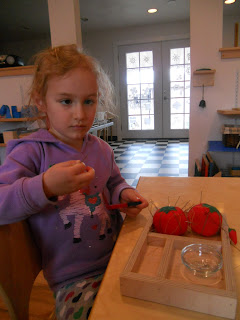
 Then the children made their own compasses (out of corks, magnetized needles, and bowls of water) to understand that the needle of a compass is magnetic and to see how they respond to the bigger magnet that is our planet.

 Then, the children learned about and visualized the Earth's magnetic field using a globe with a magnetic dipole.


Once the children understood that the needle of a compass responds to the Earth's magnetic field, they were ready to learn how to use compasses. They particularly enjoyed using them to label the room with its corresponding directions (they delight in getting this out and doing it several times a day). One child independently reasoned (based on her knowledge of polarity) that the Earth's North Pole must actually have the polarity of a south magnetic pole since it attracts the north pole of the compass needle!

 The children also examined compass roses on maps, created some compass roses, and discussed the way that a compass might be used as a literary trope.
 And, of course, the children enjoyed relaxing and reading some quality non-fiction literature about magnets and compasses.


Over the next few weeks, we will be introducing lessons on electricity into the classroom.
Thank you to my mentors: Anna Applebaum (of Mapleton Montessori) for the idea of the Magnetic Sorting Lesson, Patty West (of Boulder Montessori) for teaching me how to develop physical science units for children in this plane of development, and Susan Stephenson for the Sand/Iron Filing Sorting lesson.

 In Montessori classrooms the children are permitted to freely choose among a great variety of growth-promoting materials during the independent work period. As a result of their freedom to choose, it is always very interesting to see which materials the children are most interested in using (which can vary dramatically from year to year). Often, children will observe another student using a material and will want to imitate their use of it.


