

 "It may be doubted whether there are any other animals which have played so important a part in the history of the world, as have these lowly organized creatures."
 - Charles Darwin, 1881
Montessori guides consider a presentation to have been a "good match" when the child chooses to repeat the activity independently. Using that as my criteria, the presentation on earthworms in the garden was very well received. Not a day has passed without children racing out to the digging plot in the garden in the hopes of discovering worms, or inquiring of me "Don't you want to dig for worms in the garden?" (which translates into "Please use the pitchfork to turn over some dirt for me").

 The children are equally excited about plucking wriggling worms from the vermicompost bin and feeding the worms lunch or snack scraps has become a highly coveted task.

 Our unit on Annelids concluded with the children playing some line games in which they imitated worms, a demonstration in which they created a model of a gizzard using pebbles and a plastic bag,
 by making and illustrating booklets showing the anatomy of an earthworm,
 making worms out of playdo,
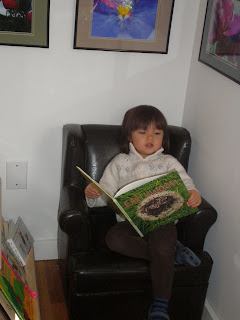
  by enjoying some earthworm non-fiction,
 and with independent lessons in which the children matched Annelid cards or sorted different species of earthworms into anecic and epigeic worms.
 If studying the diversity of earthworm species doesn't sound that exciting to you (I admit, it initially didn't to me), try imagining Driloleirus Americanus (the Giant Palouse Earthworm). It is an albino worm that lives in Oregon, Washington, and Idaho and grows to be a meter long. It burrows more than five feet below the ground, gives off a scent similar to that of lily flowers, can spit in self defense, is too fragile to be handled by humans, and is extremely sensitive to ground vibrations (making it very hard to catch). In fact, there have only been four confirmed sightings in the last 30 years! The soil is a more interesting place than I ever imagined!

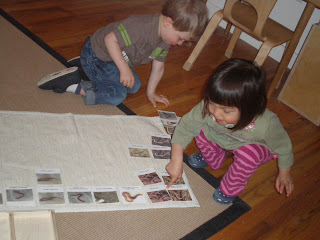
 In addition to introducing children to the earth sciences and helping to orient them in the world, these activities expose them to the basic of scientific classification, scientific nomenclature, the principles of basic anatomy, and provide additional motives for children to develop their powers of observation and description, conceptual matching (a pre-reading skill), and language arts activities (reading and working on pencil control and handwriting).
 Finally, it is really amazing to see how much less waste (particularly food waste) we have at the end of the day; between the vermicomposting and the thermophilic composting, we are well on our way to our goal of achieving zero waste lunches!
*If there are any other Montessori teachers reading this, I would highly recommend including this unit for your primary class. Unfortunately, the main manufacturers of three part taxonomy cards, Maitri and In-Print, don't have an annelid set (I emailed Julia Volkman in the hopes that they were planning to create some soon); in the meantime, if you would like to use the ones I made, send me an email. I am happy to share the cards and the lesson plans (our cards use the Getty Dubay font, as that is what we use in the classroom, so they should be easy for children learning both print and cursive to read).
