

 "The new woman, like the butterfly come forth from the chrysalis, shall be liberated from all those attributes which once made her desirable to man only as the source of material blessings of existence. She shall be, like man, an individual, a free human being, a social worker...She shall wish to be loved for herself and not as a giver of comfort and repose. She shall wish a love free from every form of servile labor. The goal of human love is not the egotistical end of ensuring its own satisfaction- it is the sublime goal of multiplying the forces of the free spirit, making it almost Divine, and, within such beauty and light, perpetuating the species."
-Maria Montessori, The Montessori Method
 This afternoon, the children convened in the yard to release the Painted Lady Butterflies they reared from microscopic butterfly eggs into beautiful adults. Although they were visibly stirred by the sunlight and fresh air, the butterflies choose to cooperate with our plan of allowing each child to carefully remove one from the cage and hold it on their palm for a few seconds before watching it flutter away into the warm spring breeze.


 Over the weekend, the first of the Painted Lady Butterflies that the class raised from butterfly eggs emerged from its


 The children are equally excited about plucking wriggling worms from the
 Our unit on Annelids concluded with the children playing some line games in which they imitated worms, a demonstration in
  by making and illustrating booklets showing the anatomy of an earthworm,
 making worms out of playdo,
  by enjoying some earthworm non-fiction,
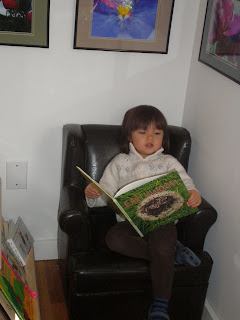 and with independent lessons in which the children matched Annelid cards or sorted different species of earthworms into
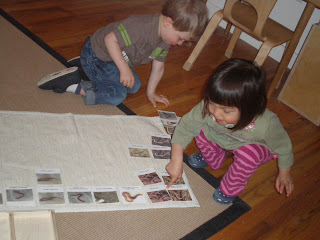
 In addition to introducing children to the earth sciences and helping to orient them in the world, these activities expose them to the basic of scientific classification, scientific nomenclature, the principles of basic anatomy, and provide additional motives for children to develop their powers of observation and description, conceptual matching (a